Candidate Screening Software: How to Choose the Right One
candidate screening software
September 10, 2026 |
9 min read
Ayush
ayush@impress.ai
Most candidate screening software gets sold the same way: a big accuracy number on a slide, a promise to cut screening time in half, and a tool that barely talks to the ATS your team already uses. Weeks later, nobody can explain why it ranked one candidate over another, and the “accuracy” number turns out to be something the vendor measured internally, on their own terms.
Resumes are easier to polish than ever, which is a big part of why resume screening is broken for teams still screening on keyword match alone.
This is a framework, not a vendor listicle: three questions to ask before you buy any candidate screening software, backed by real research and real regulations.
What Is Candidate Screening Software?
Candidate screening software reviews and ranks people after they apply for a job, sitting between your job posting and your interviews. It’s meant to answer one question: out of everyone who applied, who’s actually worth a recruiter’s time?
Most tools answer that question by matching keywords. A resume mentions “Python” somewhere and the system checks a box, regardless of whether that person used Python for three years or copied it off a job description they were rejected from twice already. That’s why so many good candidates never make it past this stage, and why so many bad fits do.
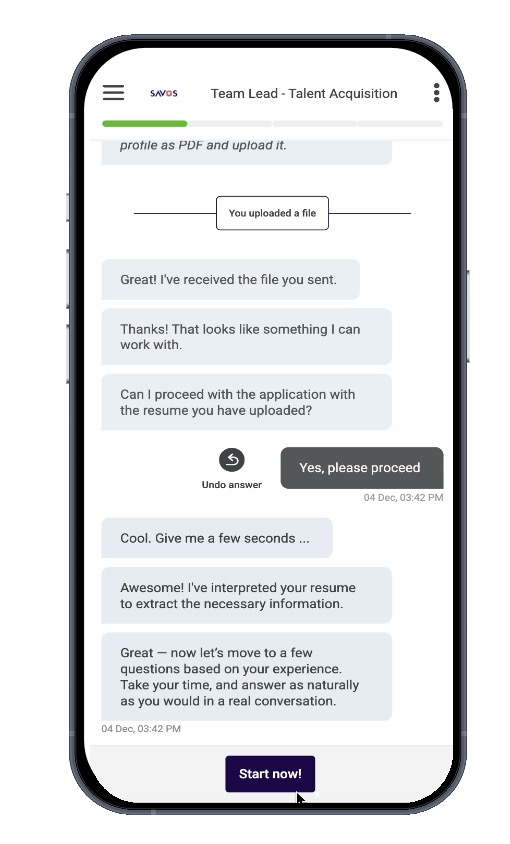
Savos ScaleScreen candidate screening in action
The better version of this software reads for context instead of counting keywords: what someone actually did, how it relates to the role, and where the gaps are, then shows its reasoning instead of handing back a single score you’re supposed to trust blind. Impress.ai’s Savos builds its screening layer, ScaleScreen, around that idea, which is worth knowing before you start evaluating vendors on accuracy, bias, and fit in the sections below.
Is the Candidate Screening Software Actually Accurate?
Ask for the method behind an accuracy number before you ask for the number. “94% accurate” compared to what: a recruiter’s judgment, who got hired, or who performed well a year later? Those are different claims, and vendors rarely say which one they mean.
The most-cited research here is Schmidt and Hunter’s 1998 review of 85 years of hiring studies in Psychological Bulletin. It found structured evaluation, meaning the same defined criteria applied to every candidate, predicts job performance far better than unstructured judgment: .51 versus .38 on their validity scale, rising to .63 when paired with a basic skills test. A 2022 reanalysis found the real gap is likely even larger. The accuracy question isn’t whether the AI seems smart. It’s whether the tool applies one defined standard to everyone, or just moves faster than a single recruiter’s gut feeling.
Three questions worth asking a vendor directly:
What was “accurate” measured against?
Will they run a pilot against your own recruiters, on the same 50 to 100 real requisitions, before you sign anything longer than a few months?
Can you see the reasoning behind one candidate’s score, not just the aggregate percentage?
ScaleScreen, the candidate screening screening tool from Savos, is built around this exact research: instead of one opaque score, it separates evaluation into visible parts, reading resumes for context, asking role-specific follow-up questions, checking named skills, flagging gaps, and surfacing relevant experience a keyword search would miss. The same principle is behind how AI assessments improve quality of hire: visible reasoning beats a single number every time.
Is the Candidate Screening Software Fair to Every Candidate?
Bias here isn’t hypothetical. It’s measured, documented, and actively regulated.
• A 2024 University of Washington study tested AI resume screening across nine jobs using 500+ real resumes and job postings. AI models favored white-sounding names 85.1% of the time and female-sounding names only 11.1% of the time; Black male candidates were passed over in up to 100% of test cases in some categories.
• Harvard Business School, with Accenture, asked employers directly: 88% admitted their own systems filtered out candidates who were actually qualified, simply because a resume didn’t match the exact job posting wording.
• The EEOC’s four-fifths rule flags bias when a tool selects one group at less than 80% of the rate of another.
The real question isn’t whether a tool carries bias risk. Almost any model trained on past hiring data does. It’s whether the vendor can prove they’ve checked it, in a way that would hold up to a regulator.
Four things worth confirming before you sign:
1. Can you see why a specific candidate scored the way they did, not just an average?
4. Does the vendor know the actual rules? NYC’s Local Law 144 requires an independent bias audit at least once a year for hiring tools used there, with results made public. The EU AI Act treats hiring AI as high-risk, with its own audit requirements.
Savos builds ScaleScreen around the same standard: every score traces back to something specific in a candidate’s background or answers, criteria stay visible to your team, and the final call always stays with a person.
Will the Candidate Screening Software Work With Your ATS?
Good screening software sits on top of the ATS you already have. It shouldn’t require moving years of candidate history into a new system, and this is the question buyers skip most often.
Your ATS is your system of record: it stores applications and tracks pipeline stages, but it was never built to judge whether someone can do the job. Most ATS “match scores” are keyword overlap, the same mechanism the research above shows filters out good candidates. Screening software’s job is to add the judgment layer the ATS can’t. Some vendors use “screening” as a way in to sell a full platform replacement instead. Getting this handoff right pays off past the offer stage too: disconnected HR tech is exactly why the candidate experience falls apart after someone’s hired.
Check before you sign:
Does the tool read applications from your ATS and write evaluations back into it, or does it require a separate portal? A separate portal means recruiters work across two systems, which is how expensive tools go unused within months.
What ATS versions are actually supported, and what’s the real setup timeline for a team your size?
How to Pick the Right Candidate Screening Software
Ask for proof, not a percentage. Structured, defined criteria predict good hires. A polished number with no method behind it doesn’t.
Ask for the reasoning, not just the score. Confirm explainability, an independent bias audit, and a logged override trail.
Ask how it actually fits your systems. Confirm it adds onto your ATS instead of asking you to rebuild your stack.
A vendor who answers all three with evidence has earned a real evaluation. A vendor who answers with a demo and a big number hasn’t. That’s also where the real ROI of AI hiring tools comes from, not the pitch deck.
A lot of what’s sold as “candidate screening software” is a fast filter wearing an AI label: good at sorting a pile, not built to evaluate what’s in it. ScaleScreen was built for the second problem, and what it learns during screening feeds forward into interview prep and a single candidate record, so that work doesn’t disappear once someone reaches the interview stage. Whether that connected structure matters for your team is worth weighing against your own setup. For teams weighing a screening layer against switching platforms entirely, our comparison of Savos vs. Greenhouse covers two different bets on what AI should do in hiring.
Do I have to replace my ATS to use candidate screening software?
No. A well-built tool sits alongside your ATS, reading applications and sending evaluations back through a real integration. If a vendor’s pitch requires migrating your whole candidate database, treat that as a major cost, not a detail.
How do I check a vendor’s bias claims instead of just trusting them?
Ask who has actually put the tool through independent testing, not just what the vendor ran on its own. Savos went through exactly that kind of evaluation when the AI Verify Foundation featured it as a global case study at ATxSummit 2026, testing its resume scoring and conversational screening against outside frameworks including the EU AI Act, ISO/IEC 42001, NIST’s AI Risk Management Framework, and NYC’s Local Law 144 audit requirements. That’s the standard worth holding any vendor to: a named third party, named frameworks, and a case study you can actually go read, not a slide that says “bias-tested.”
Can AI screening make bias worse instead of better?
Yes, depending on whether it’s been checked. A 2024 University of Washington study found AI resume screening favored white-sounding names 85.1% of the time in the scenarios tested. Explainable, independently audited tools are the exception, not the default.
What’s the real difference between screening software and my ATS’s match score?
ATS match scores are keyword overlap, the mechanism behind the 88% admitting their own systems filtered out candidates who were actually qualified in the Harvard Business School and Accenture study. Real screening software evaluates actual skill and relevant experience instead, regardless of whether a resume uses your exact job posting language.
Is depth-based screening software the same as tools like Paradox or HireVue?
No. Chat-based and video tools are built for speed at high volume. Depth-based tools like Savos are built for evaluation quality, showing evidence a recruiter can question instead of a pass or fail.
How long before I see results from candidate screening software?
Expect a real pilot against live job openings, not just a demo. Most cloud-based tools go live technically within days; the real timeline is how long it takes your team to trust and use the output, which a pilot benchmarked against your own recruiters is built to show. If speed is what’s driving the search, our deep dive on time-to-hire breaks down where that delay actually comes from.
By Dr. Vaisagh Viswanathan (VT), CEO & Co-founder, impress.ai We were recently asked for input to an industry consultation on testing agentic systems. That work has since been published as IMDA’s Starter Kit for Testing Agentic Systems for Safety and Reliability, which cites impress.ai among its sources. The consultation deck separated outcome testing from trajectory […]
Here’s an uncomfortable detail from the 2026 Hiring Benchmarks Report from Starred. Nearly 90% of candidate survey invitations in 2025 went to rejected candidates, and about 70% of those rejections happened at the application stage. For most applicants, the whole candidate experience is a form, a wait, and an email. Often with no human anywhere […]
Every January for the last four years, someone has published a list of “AI recruiting trends to watch,” and every year the list looks suspiciously similar to the one before it: faster screening, less bias, better candidate experience. Readers have learned to skim past it. 2026 is actually different, and not for a flattering reason. […]